
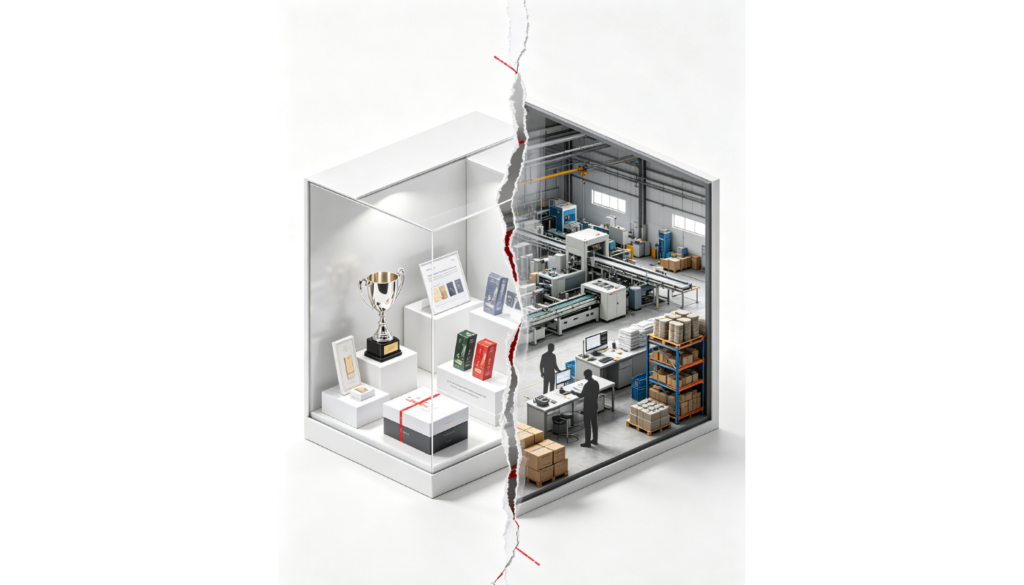
One of the most common questions in international procurement is surprisingly simple:
Is this supplier truly a manufacturer—or simply presenting itself as one?
For many buyers, the answer appears obvious after browsing a website, reviewing a company profile, or watching a factory video.
Unfortunately, these are often the easiest parts to curate.
A supplier’s true identity is rarely defined by what it claims. It is reflected by whether its operational signals consistently support those claims.
At E8lens™, we help international buyers better understand Chinese suppliers through the E8 Enterprise Visibility System, using Structured Operational Analysis to provide greater clarity before important sourcing decisions.
Why Labels Can Be Misleading
Terms such as:
- Manufacturer
- Factory
- OEM / ODM
- Industrial Group
appear across supplier websites, company brochures, and B2B platforms.
These descriptions may be completely accurate. They may also represent only part of the business model.
The real question is not:
“What does the supplier call itself?”
Instead, buyers should ask:
“Does its operational reality consistently support that identity?”
Looking Beyond the Surface
Rather than relying on a single document or marketing statement, experienced buyers compare multiple operational signals and evaluate whether they form a consistent business picture.
Does the company’s registration history support its claimed industry experience? Frequent company name changes or repeated business restructuring may deserve additional attention.
Governance Stability
Has the legal representative recently changed? Leadership changes are common. However, when combined with other operational signals, they may indicate restructuring, ownership transition, or financial pressure.
Operational Location
Does the registered or operating address logically support the supplier’s claimed manufacturing capability? A company promoting itself as a manufacturer while operating primarily from a commercial office building does not automatically indicate risk—but it raises questions that deserve further verification.
Workforce Signals
Manufacturing businesses usually leave organizational footprints. If public employment records indicate only a small registered workforce while large-scale production capacity is heavily promoted, buyers should understand why the difference exists.
Historical Consistency
Has the company maintained stable operations over time? Or has it experienced frequent address changes, ownership adjustments, or repeated organizational restructuring?
Individually, none of these signals determines risk. Collectively, however, they often reveal how a business actually operates.
A Practical Example
Imagine a supplier that presents itself as a large manufacturing enterprise. Its website displays modern production facilities and impressive manufacturing capabilities.
However, publicly available operational records reveal that:
None of these facts alone proves that the supplier is unreliable.
However, when several operational signals consistently point in the same direction, buyers gain a much clearer understanding of the supplier’s operating reality. That is where deeper supplier due diligence becomes valuable.
Enterprise Visibility Is About Consistency
Through the E8 Enterprise Visibility System, E8lens™ does not define a business using one isolated fact. Instead, we evaluate whether multiple operational signals consistently reinforce one another.
Supplier identity is not established by a marketing label. It is established by the consistency between:
- Corporate history
- Governance structure
- Operational footprint
- Workforce signals
- Long-term business behavior
No single observation defines a business. Meaningful insight comes from understanding how multiple operational signals connect and reinforce one another.
Conclusion
A reliable supplier is rarely identified by a single certificate, factory photograph, or promotional statement. It is identified through consistent operational evidence observed over time.
Before making an important sourcing decision, ask one simple question:
“Does the supplier’s operational reality support its commercial narrative?”
Better supply chain decisions begin with better enterprise visibility.
Discover the E8 Enterprise Visibility System
Learn how E8lens™ helps international buyers better understand Chinese suppliers through the E8 Enterprise Visibility System and Structured Operational Analysis.
Whether you are evaluating a new supplier, comparing multiple sourcing options, or preparing for an important commercial decision, greater enterprise visibility helps reduce information asymmetry and improve decision quality.
Request Your E8 Visibility Profile
About E8lens™
E8lens™ is an independent enterprise visibility platform focused on helping international buyers better understand Chinese enterprises before important sourcing and commercial decisions.
Rather than relying on isolated data points or marketing materials, the E8 Enterprise Visibility System connects multiple operational signals to build a clearer understanding of an enterprise’s operational reality.
Every E8 Visibility Profile is developed using Structured Operational Analysis, helping buyers gain greater visibility, reduce information asymmetry, and make more informed commercial decisions.
Better Supply Chain Decisions Begin with Better Enterprise Visibility.