
Learn five operational signals that international buyers can use to better understand whether a Chinese supplier’s manufacturing claims align with its business reality. Independent insights from E8lens.
One of the most common questions in international procurement is whether a supplier is truly manufacturing its own products.
The answer is rarely as simple as checking a website or asking a sales representative.
Many suppliers describe themselves as manufacturers. Some are. Others coordinate production through broader supplier networks.
Understanding the difference helps buyers make more informed sourcing decisions.
At E8lens, we help international buyers better understand Chinese suppliers through structured operational analysis, enabling more informed sourcing decisions before contracts are signed or payments are made.
Why One Signal Is Never Enough
- A registered office in a commercial building does not automatically mean a company is not a manufacturer.
- Neither does a small registered workforce.
- Nor does a recent legal representative change.
Rather than relying on isolated observations, experienced buyers compare multiple operational signals to understand whether a supplier’s business reality consistently supports its commercial claims.
Five Operational Signals Worth Understanding
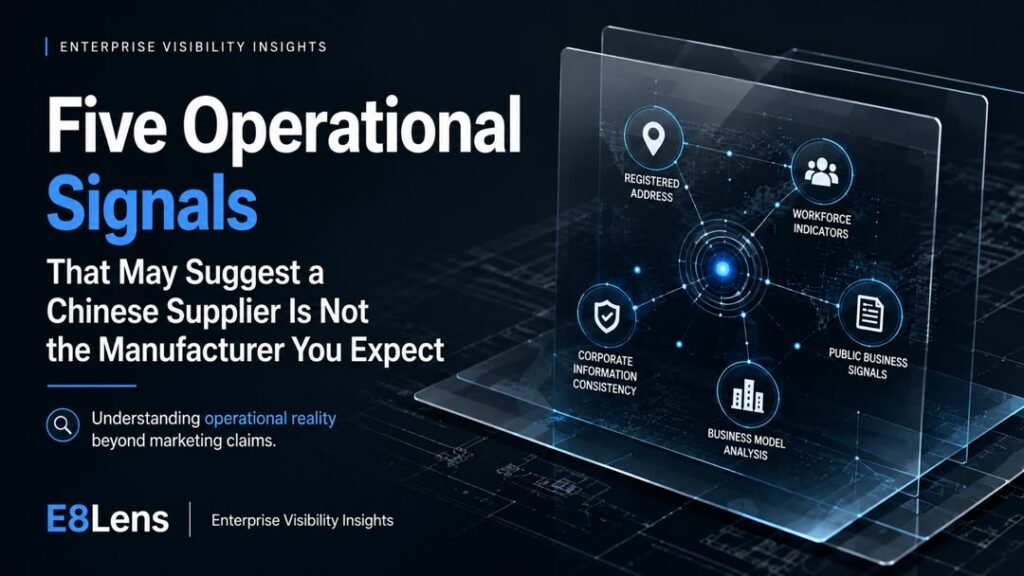
- The Registered Address Doesn’t Match the Claimed Manufacturing Activity
Some manufacturers register administrative offices separately from production facilities.
However, if no operational footprint supports manufacturing activity, buyers may wish to better understand how production is actually organized.
- A Very Small Registered Workforce
Some highly specialized manufacturers operate efficiently with relatively small teams.
However, when workforce information appears inconsistent with the claimed production capacity, it becomes worthwhile to understand whether manufacturing is internally managed or externally coordinated.
- Frequent Changes in Corporate Information
Business evolution is a normal part of growth.
However, repeated changes to company names, registered addresses, legal representatives, or business scope within a short period may indicate broader organizational adjustments that deserve additional attention.
- Public Business Signals Don’t Support the Marketing Narrative
A supplier may describe itself as an established manufacturer with extensive production capability.
However, when publicly available operational signals consistently fail to support those claims, buyers should take time to understand why the differences exist.
- Multiple Signals Point Toward a Different Business Model
A supplier may not operate as a traditional manufacturer.
Instead, it may function as a sourcing coordinator, production integrator, or distribution-focused enterprise.
None of these business models are inherently problematic.
The important question is whether the supplier’s operating model aligns with your sourcing objectives, delivery expectations, and long-term partnership strategy.
The Question Is Not “Manufacturer or Not”
The purpose of supplier evaluation is not to prove whether a company is right or wrong.
It is to understand how the business actually operates.
A trading-oriented enterprise may outperform a factory in responsiveness.
A factory may outperform a distributor in customization.
Rather than drawing conclusions from any single observation, experienced buyers look for consistency across multiple operational signals before making important sourcing decisions.
Better decisions begin with understanding operational reality rather than relying on labels.
Enterprise visibility is built by connecting operational signals—not by drawing conclusions from isolated observations.
The more consistently those signals align, the clearer a supplier’s operating reality becomes.
That is why structured operational analysis has become an increasingly valuable part of modern supplier evaluation.
Discover the E8lens Enterprise Visibility System
Learn how E8lens™ helps international buyers better understand Chinese suppliers before important sourcing decisions.
Request Your E8lens Visibility Profile
About E8lens™
E8lens™ is an independent enterprise visibility platform focused on helping international buyers better understand Chinese enterprises before important sourcing and commercial decisions.
Rather than relying on isolated data points or marketing materials, the E8 Enterprise Visibility System connects multiple operational signals to build a clearer understanding of an enterprise’s operational reality.
Every E8 Visibility Profile is developed using Structured Operational Analysis, helping buyers gain greater visibility, reduce information asymmetry, and make more informed commercial decisions.
Better Supply Chain Decisions Begin with Better Enterprise Visibility.